
Hi everyone —
Happy Thanksgiving.
I share a lot about about what we’re working on at Eddie, our mission to liberate you to craft epic videos, and the latest drops (thanks CineD for the coverage this week).
I haven’t shared as much about the trials and tribulations of company building.
One year ago, Eddie was in a bad place.
Alex and I spent all of Thanksgiving weekend (Thurs to Saturday) on calls.
We launched Eddie v1 in Oct 2024. It was a dream launch.
Thousands of new users. Lots of positivity from friends and new sign ups.
But by November, it was clear: most users weren’t sticking around.
And Eddie wasn’t good enough.
So Alex and I did what founders must. Stop everything. Stare truth in the face. Sacrifice festive times. And we deconstructed the product, the target customer, their use cases. And to see where we were falling short.
Those were intense times. We felt the urgency to quickly identify the root causes, and then to fix them. It took two months to right user retention.
And the change was palpable. Bit by bit, users stuck around. They used the product more often. They wrote to us what they loved (and what we should add — and we did and continue to do so!!).
Eddie is in a very different place today, Thanksgiving 2025. Eddie is a real company, with real customers and revenue. And it’s also still early days. We have much to do towards our mission.
I am grateful to Alex, my whole team, and our many many customers who stuck with us and see the big dream. (And thank you to my family for your understanding while I am again on the computer and phone.)
I wish you a wonderful Thanksgiving with friends and family, filled with a lot of gratitude, joy and happiness.
—Shamir

For Your Consideration (FYC):
An industry term for the marketing campaigns studios and distributors deploy during awards season to sway Academy voters. FYC encompasses everything from full-page spreads in Variety and The Hollywood Reporter to private screenings, Q&A events, swag bags, email blasts, and surgical outreach to key influencers.
Late January. A glass-walled conference room in West Hollywood. The nominations for the 96th Academy Awards have just dropped, and inside this boutique PR war room, no one is celebrating.
A strategist. With their monthly retainer exceeding the entire budget of the low-budget short they’re repping draws concentric circles on a whiteboard: Short Films Branch. Documentary Branch. Executive Committee.
We have a problem.
Voters aren’t watching the screener. They’re clicking ‘next.’ We need urgency. We need guilt. And we need a celebrity EP by Friday.
Behind the craft and artistry of all 340 Oscar-qualifying short films lies a different conversation entirely. One about extraction.
Extracting votes from a distracted, aging electorate that can’t be bothered to watch.
Today we dive into the machinery: the budgets, the whisper campaigns, the surgical targeting, and the quiet gatekeepers who engineer outcomes in one of the Academy Awards’ most manipulable categories.
THE SIX GATES OF ELIGIBILITY

1. Make a film of “note”
Doesn’t have to be “good” but it needs to be noteworthy. Shorts live or die on immediacy: a hook, a feeling, an urgency that a programmer or juror can grasp in under a minute.
2. Submit to an Oscar-qualifying festival
The Academy maintains a long, sprawling list of 162 qualifying festivals across animation, documentary, and live action. Your only real job here is strategy: target festivals that actually give out the specific qualifying awards in your category.
The official list spans everything from Cannes and Sundance to shorts linchpins like HollyShorts and Clermont-Ferrand. To the lesser-known obscure qualifiers around the world such as Alexandria Short Film Festival in Egypt or Lebu in Chile
3. Win a qualifying award
This is the choke point. You don’t get to submit unless you win one of the designated awards at one of those festivals. Second place doesn’t count. Audience award doesn’t count. “Special Mention” doesn’t count.
4. Or… buy your way in with a 7-day theatrical run
The Academy allows a second, far more direct path: pay for a continuous seven-day commercial theatrical run in either Los Angeles or New York, with publicly available showtimes and paid tickets.
No festival. No jury. No award. If you can afford the screens, you’re eligible.
5. Submit to the Academy
Once you’ve paid for a 7-day run or won a qualifier, you can submit your film to the Academy for consideration. This is where the real expenses start: hosting on the Academy Screening Room, watermarking, security fees, and the paperwork that quietly filters out underfunded contenders.
6. Survive the Branch Review
Your film is now in the system. But you’re not campaigning yet. First, the relevant branch (Documentary, Animation, or Shorts & Feature Animation) needs to view, rank, and sift through the field to create the shortlist.
Only after you make the longlist does the Oscar campaign truly begin.
Crossing these six gates is like getting on the ballot in a city-wide election but it doesn’t make you competitive yet. It makes you a player.
SHADOW CABINET

To understand how an Oscar is “secured”, you need to understand the electorate. In the Academy Awards ecosystem, Short Film categories function like municipal elections: low turnout, uninformed voters, and results determined by power brokers who mobilize specific voting blocks.
Mechanics of Apathy
Unlike Best Picture, where members receive screeners and cultural pressure to watch, Shorts suffer from profound apathy. Historically, only a fraction of the 10,000+ members watch the Short Film bundles, creating a “low-turnout election” that favors organized minorities over the general will.
“Opt-In” Illusion
The Academy eliminated theatrical screening requirements, moving voting to the online Screening Room. While this democratized access, it also democratized negligence as voters can cast ballots without watching, relying on “For Your Consideration” campaigns.
This spawned an entire industry of “Sherpas”. The consultants who don’t sell the film but sell the obligation to watch it, functioning as campaign managers in a district where 90% of voters are asleep.
The Long List:
A full intake of every single short that met the Academy’s requirements for the year and was submitted by the filmmaking teams.
Roughly 340 films across Live Action, Documentary, and Animation as an unfiltered mix of studio-backed projects, festival breakouts, shoestring indies, and student films with resources. The Academy doesn’t rank, recommend, or spotlight anything at this stage; it simply dumps them into the system.
For most voters, this list might as well not exist as they’ll never sift through hundreds of titles.
The Less-Long List
Around early-to-mid December, 340 films become 15. This is where the culling begins. And hovering over the entire process is the Executive Committee. An influential group with the power to “save” films they believe were unfairly overlooked or, just as quietly, bury films that don’t fit the season’s preferred narrative. Democracy with a safety valve, in case the wrong films advance
The Short List
15 films now become 5 and once those slots are set, the power shifts to the full Academy membership. From the final 5, one film will be chosen as the “best short” at the official ceremony.
A $300K WAR CHEST

The most pervasive myth in the Shorts ecosystem is that it’s a low-cost entry point into the Academy. Filmmakers are told that if they make a brilliant film for $15,000, they have a shot at glory.
They do but they also don’t.
The reality is a pay-to-play economy where the campaign budget often exceeds the production budget by a factor of ten.
Academy Screening Toll
To even exist on the playing field as in just having your film available on the Academy’s streaming platform for voters there’s a toll charge.
$12,500 to $20,000 just to upload a film to the Academy Screening Room (ASR) for the “For Your Consideration” section.
Add an additional $5,000 fee for forensic watermarking.
For a studio like Disney or Netflix, $25,000 is a rounding error. For an indie filmmaker who crowdfunded $20,000 to shoot their film, this fee is an insurmountable wall. This single line item effectively gentrifies the Oscars, handing the advantage to studio-backed projects or independently wealthy producers before a single vote is cast.
Tools of the trades
No film wins without specialized PR. These aren’t publicists; they’re awards strategists with the Branch Executive Committee on speed dial.
Top-tier firms (ID, 42West, Rogers & Cowan) charge $5,000–$15,000 monthly. A typical six-month campaign: $60,000–$90,000 in base costs.
Contracts include “bounty” clauses, $5,000–$10,000 for a shortlist, $15,000–$25,000 for a nomination, $20,000–$50,000 for a win.
While big firms handle features, boutique outfits like Joshua Jason PR, London Flair, and Mediaplan PR dominate Shorts, waging guerrilla warfare in the branches, knowing precisely which festivals to target and which voters to schmooze.
To exist in voters’ minds, a film must exist in the trades. A single full-page ad in Variety or THR costs $15,000–$30,000. Serious campaigns require a “flight” of ads and weekly reminders that “This Film Exists.” Private voter receptions run $5,000–$10,000 each for venue, catering, and moderator fees.
Check Please
When you tally the costs, ASR fees ($20k), PR retainers ($60k), Trade Ads ($50k), Events ($20k), and Travel/Tastemaker costs ($30k) the “minimum effective budget” for a winning Short Film campaign sits between $150,000 and $300,000.
This financial reality creates a perverse incentive structure. The Oscar for Best Short Film is rarely awarded to the “best” film (whatever that means); it is awarded to the film with the deepest pockets. It is an asset class, purchasable by those willing to invest the capital.
And the obvious question is:
Who on earth is paying for all that? For a short?
It’s never the director.
This scale of spending is far beyond Kickstarter energy, or maxed-out credit cards. Once a short enters Oscar territory, the financial burden shifts upward. We’re talking distributors, platforms, and EPs.
Prestige outlets like Netflix, The New Yorker, and NYT Op-Docs bankroll campaigns to boost their brand aura.
Boutique distributors treat an Oscar run as marketing ROI. And studios fund shorts the same way they fund awards pushes for features: as part influence play, part bragging rights, part future leverage.
There are even whispers about foreign nationals buying EP credits by bankrolling a short’s Oscar campaign to essentially purchase the “exceptional recognition” needed for certain U.S. visa categories.
For anyone outside the industry, it’s a shortcut to manufactured clout. And for high-net-worth individuals, dropping $50K–$100K to do it is barely an inconvenience.
SHERPAS AND THE LOBBY
The campaign for a Short Film Oscar is a ground war, fought in the living rooms of Pacific Palisades and the cocktail mixers of the San Fernando Valley.
Carter Pilcher and ShortsTV: As CEO of ShortsTV, Pilcher monopolizes theatrical distribution of Oscar-nominated shorts. He’s also an Academy voting member and key influencer. ShortsTV’s annual theatrical release is the only revenue generator for most shorts, making Pilcher’s favor essential.
Linda Olszewski (”Linda O”): A veteran Academy member and ShortsTV executive who advises filmmakers on “campaignable” lengths and serves as frequent jury member. AKA a Shorts Sherpa. Her endorsement signals to voters that a film is “legitimate”.
Tatiana Detlofson (Mediaplan PR): The architect of “surgical strike” campaigns, specializing in bypassing expensive studio-style promotions to target the Executive Committee directly. Her strategy positions films not as entertainment but as discoveries the committee must “save” to demonstrate their refined taste.
The “Block Captain” System: While Academy rules forbid direct lobbying, consultants simply migrated to unverifiable channels. They utilize influential “Block Captains”. Chatty branch members who “organically” socialize films at screenings and dinner parties. A consultant calls the Captain to “catch up,” casually mentions a film, and the Captain repeats it. The endorsement appears spontaneous. It’s not. It’s a planted narrative seed, watered by retainer fees.
the whisper network

In a low-information election, negative rumors travel faster than positive endorsements. Because voters rarely research Short Films, a single damaging whisper can sink a campaign.
The tactic is simple: competitors whisper that a documentary “staged” scenes or a narrative short “plagiarized” its concept. During the 2021 campaign, filmmaker Cynthia Kao accused Two Distant Strangers of lifting the premise from her short Groundhog Day for a Black Man.
The filmmakers engaged in aggressive damage control but not publicly, which would give the accusation oxygen, instead within the whisper network itself. They reassured voters that “time loops” are generic tropes and reframed the accusation as an attack on a “Black trauma” narrative the Academy needed to validate. The whisper campaign was suffocated by a louder narrative of “social urgency.”
It’s crisis management as performance art: when accused of theft, simply make the accusation itself sound like the real crime.
BALLOTS OF SHAME
The most damning evidence against the meritocracy of the Shorts Oscars comes from the voters themselves. Every year, The Hollywood Reporter and other outlets publish “Brutally Honest Oscar Ballots”, a charming annual tradition where Academy members anonymously admit they couldn’t be bothered to watch the films.
These confessions reveal what we might generously call negligence in the Shorts categories, though brazen indifference might be more accurate. One voter admitted to not watching the Animated Shorts and letting their “kids pick the winner”. Another declined to watch a film “because they didn’t like the movie that came before.”
HOW TO ACTUALLY WIN
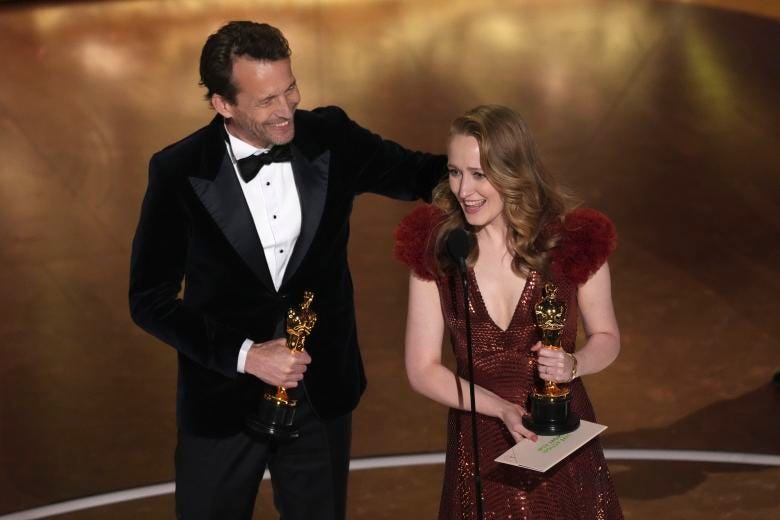
Based on the data, here is the slightly snarky playbook for winning the Oscar for Best Short Film. If you want the statue, follow this script.
Phase 1: The Setup (Development)
Do not write a script based on a “cool idea.” Audit the news. Find a “cause” and let the film be a “tool for change,” not just a movie.
Get a celeb Executive Producer. Yes, it’s that simple. No, I won’t tell you how.
Phase 2: The Credibility (Festivals)
Skip the small festivals. You need a “Qualifier” status immediately. Target Sundance, Telluride, Tribeca, or HollyShorts.
You must win a qualifying award. This is the ticket to the dance.
Phase 3: The Campaign (The “War”)
Hire Sherpa: Retain Linda Olszewski, Tatiana Detlofson, or a firm like Joshua Jason PR. Budget $10,000/month for this. If you can’t afford them, you lose.
Secure distribution with The New Yorker, Netflix, or NYT Op-Docs. If you are on Vimeo alone, you are invisible.
Pay the $20,000 ASR fee. Do not complain. It is the cost of doing business.
Phase 4: The Ground Game (Lobbying)
Target the Executive Committee. Host private dinners in Pacific Palisades. Get “Block Captains” to mention your film at drinks.
Your FYC ads must imply that not voting for this film is a moral failure. Use the phrase “Essential Viewing.” Use quotes from your Celeb EP.
If a whisper campaign starts (e.g., plagiarism, fabrication), do not engage publicly. Kill it privately with “Block Captains.”
Phase 5: Win (Graciously)
When your name is called, appear genuinely surprised. Practice this in the mirror if necessary.
In your speech, thank the Academy for “recognizing stories that matter” and emphasize that this win “isn’t about me” it’s about the community/cause/movement.” Do not mention your PR team, your EP who wrote the check, or the $200,000 campaign budget.
Update your email signature to include “Academy Award Winner.”
Begin developing your first feature. You now have approximately 18 months of heat. Use it wisely.
FINE PRINT
Despite how strategic and cynical this all sounds, you still have to make a genuinely strong film because no bad short has ever cracked the Oscars final five. At a minimum, an Oscar contender needs sharp cinematography and a story that lands.
Everything after that is campaign architecture. You’ve seen the playbook, but the execution only matters if it aligns with the Academy’s calendar, and those windows close fast.
And let’s be honest: if you’re reading an article like this in November, you’re probably not in this year’s race.
But if you’re thinking about next year, or gearing up for your first real push, consider the curtain pulled back. Now you know how an Oscar actually gets won. It’s both harder than it looks and, in the strangest way, easier too.
The final Oscar shortlist drops on January 22, and the winners are crowned on March 15.