
Our penultimate Render Time for 2025.
A director went to prison for crypto-gambling Netflix’s money. The Oscars are leaving ABC after 67 years. Gen Z is out-attending every other demographic at theaters. Google Earth spoiled a TV show months early through satellite imagery. YouTube nuked AI trailer channels with millions of subscribers. Physical media is somehow back.
Every month this year has been stranger than the last so what does 2025 have left to throw at us in its final week?
Render Reel
Pluribus Gets “Spoiled From Orbit” Thanks to Google Earth
At-home sleuths spotted a huge message on the show’s Albuquerque cul-de-sac set in Google Earth’s historical satellite imagery captured as far back as Aug 30, 2024.
Blackmagic Camera 10.0 Adds 10-Minute Pre-Record + 4-Channel Audio to URSA Broadcast G2 & PYXIS
A free firmware update turns these cameras into never-miss-it machines, caching up to 10 minutes before you hit record and doubling onboard audio tracks to four for faster doc/news/event turnaround.
ARRI Says the Rumors Are Noise: Lighting + High-End Cinema Stay Core
After restructuring chatter, ARRI touts a 2026+ lighting roadmap and continued camera ecosystem investment.
Creators Coalition Forms in response to AI A new cross-industry convening group is organizing around four pillars in hopes of guardrailing the AI revolution.
Sundance 2026 Shorts Lineup Includes Luigi Mangione Doc + Steph Curry Film
The shorts program leans into cultural flashpoints and celebrity-backed nonfiction, with a Luigi Mangione-focused short and a Steph Curry/Ben Proudfoot co-directed project among selections.
The Director Who Stole $11M From Netflix
A New York jury swiftly convicted filmmaker Carl Rinsch this week for orchestrating one of streaming’s most brazen frauds, finding him guilty of stealing over $11 million in Netflix production funds for personal stock market bets and cryptocurrency gambles because apparently directing wasn’t thrilling enough.
The 47 Ronin director now faces up to 90 years in prison for wire fraud and money laundering, though sentencing on April 17, 2026 will likely yield a fraction of that maximum.
The catastrophe began in 2018 when Netflix’s then-content chief Cindy Holland aggressively poached the sci-fi series White Horse (later Conquest) from Amazon for a staggering $61 million.
With Keanu Reeves vouching for Rinsch’s vision, the director secured final-cut authority, a creative concession that certainly aged well. After burning through $44 million with little to show, Rinsch demanded another $11 million in 2020 for supposed production needs. Instead, prosecutors proved he diverted these funds to speculative trading and luxury purchases.
By 2021, Netflix had nothing but teaser clips and terminated the project, writing off $55 million.
This case represents everything wrong with streaming’s early “growth-at-all-costs” era. Holland’s aggressive content grab created conditions ripe for exploitation. Granting final-cut power to a director whose previous film (47 Ronin) was a notorious box-office bomb reveals the kind of due diligence you’d expect from someone handing cash to a stranger at a casino.
What’s particularly bold is Rinsch’s courtroom audacity, testifying he actually deserved more money after gambling away millions meant for production. The swift jury deliberation suggests his defense was about as convincing as his filmmaking track record.
Gen Z Sparks Cinema Revival
Cinema United’s 2025 “Strength of Theatrical Exhibition” report delivers surprising news: Gen Z is reviving cinema.
Gen Z attended an average of 6.1 films this year, up from 4.9 in 2024 and outpacing every other demographic. Within Gen Z, 41% saw six or more movies, a figure that’s surged over 30% since 2022.
While overall domestic ticket sales remain 23% below 2019 levels, the data suggests theaters are successfully transforming their customer base.
Cinema United President Michael O’Leary emphasized that “weekend box office” metrics miss the bigger picture. He found that premium large-format screens, in-seat food ordering, and deluxe lounge seating specifically attracted younger audiences because apparently Gen Z discovered they enjoy not watching movies on their phones.
Meanwhile, 77% of Americans aged 12-74 saw at least one film theatrically, representing over 200 million admissions.
Films like Marty Supreme and One Battle After Another weaponized viral marketing through younger stars like Chase Infiniti and Timothée Chalamet, turning theatrical releases into unmissable social events rather than content to stream later while doom-scrolling.
There’s also a social penalty now for not showing up on release week. Letterboxd logs, Film Twitter discourse, and ranking threads all move fast.
If you don’t see a film when it drops, you’re instantly out of the loop. Streaming later doesn’t count the same way because the conversation has already moved on.
YouTube Nabs an Oscar
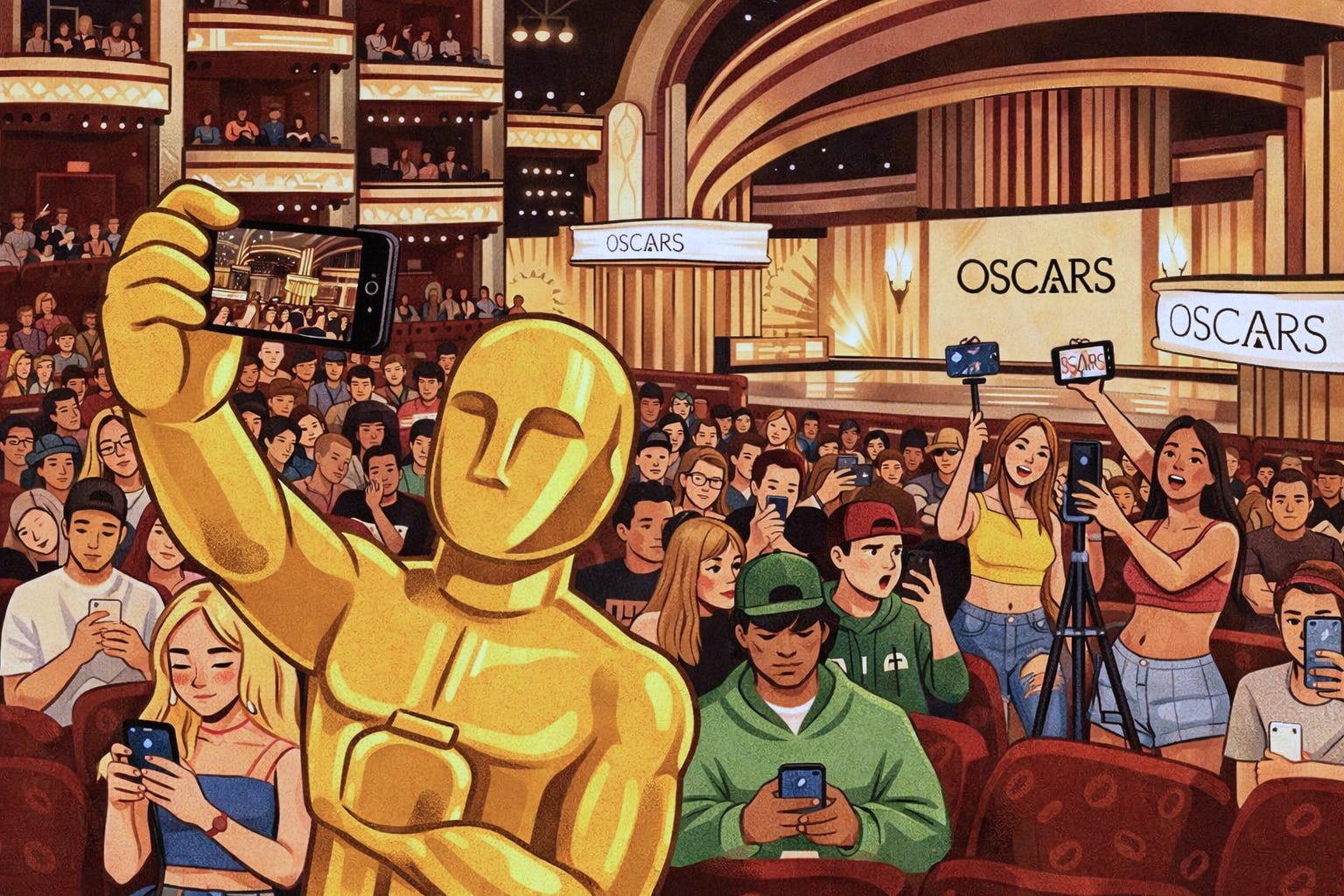
The Academy Awards will abandon ABC after 67 years and migrate exclusively to YouTube beginning in 2029.
The five-year global streaming deal (running through 2033) grants YouTube rights to the entire Oscar ecosystem: the main ceremony, red carpet coverage, Governors Awards, nominations announcements, and behind-the-scenes content…all streaming free to YouTube’s 2 billion worldwide users.
ABC have broadcast the Academy Awards since 1961 but the 100th Oscar ceremony will be its last. While the 2025 ceremony drew a respectable 19.7 million viewers it represents less than half the format’s 1999 peak, when 55 million watched Titanic sweep. The Academy chose YouTube over Netflix and NBCUniversal/Peacock, making the Oscars the first of the “Big Four” awards (Oscars, Grammys, Emmys, Tonys) to completely abandon broadcast television.
YouTube might solve the Oscars’ existential crisis.
Traditional broadcasts forced three-hour runtimes, relegating technical categories to commercial breaks and playing off emotional speeches. Streaming might eliminate those constraints, potentially allowing full cinematography showcases and unrushed acceptance moments that could actually go viral on... YouTube.
This mirrors Gen Z’s 25% moviegoing frequency increase: premium experiences optimized for social sharing. The ceremony becomes content Gen Z can clip and remix exactly how they already consume everything else.
YouTube Nukes Two Major AI Fake-Trailer Channels After Metadata Crackdown
Screen Culture and KH Studio (over 2M subs and 1B+ views combined) were terminated for violating spam/misleading policies after repeatedly blurring “fan concept” framing and gaming search visibility.
DVDs and CDs Get a Gen Z Bump as “Ownership Culture” Creeps Back
Collectors (and streaming-fatigued viewers) are driving a small-but-real physical media rebound.
Cut of the Week - NATURALLY: A Fashion Film by SHOWstudio and Ray-Ban Meta
Working with SHOWstudio and Ray-Ban Meta Gen-2 glasses, legendary fashion photographer Nick Knight flips the usual fashion-film hierarchy.
Instead of a locked camera and a subject performing for the lens, the camera becomes embodied as he literally walks the image into existence.
The core technique is something called Gaussian Scanning.
Rather than capturing a subject from a single hero angle, Knight circles each model multiple times wearing the glasses, recording continuous 3K video. Those passes are later extracted into volumetric data, generating a 3D scan that can be re-situated inside scanned landscapes.
What’s new here is how much decision-making happens during capture as Knight directs the system in real time:
Hey Meta, I’m about to start shooting. Start recording in 3K.
Hey Meta, remember these lighting settings for me.
Hey Meta, how’s the battery life looking?
Even the environments followed the same logic.
In the weeks leading up to the shoot, Knight and his assistants scanned nature the same way they scanned models. Slow walks and multiple passes.
The result is an impressionistic surface that feels handmade despite being deeply computational.
Retail Therapy
Vasco Translator Q1: Voice-Cloning Pocket Interpreter $660

Vasco’s Q1 is a stand-alone translation device that goes beyond basic phrase flipping: real-time voice translation across 80+ languages, photo translation via a built-in camera, and live phone-call translation without a subscription.
The voice cloning feature plays back in a translated approximation of your own voice though it’s still hit-or-miss. Pricey next to smartphones, but for travelers who want fewer taps and more certainty, it’s worth a look.
If you’re reading in the app, tap the little ❤️ so we know you’re out there.”