
Also this week
Instagram starts giving editors algorithmic notes, YouTube turns Shorts into TV, ARRI puts LogC3 inside a phone, and somebody gives a DJI Pocket false colour because apparently nothing is allowed to remain a consumer product anymore.
Render Reel
Instagram’s editor can now tell you where your audience got bored. Meta’s AI assistant inside Edits can use your metrics to suggest hooks built around what’s actually performing.
YouTube turns Shorts into TV. Creators can now organise vertical videos into seasons and episodes with sequential playback, while microdramas pulled more than 6.5 billion views in the first half of 2026. People are watching YouTube on TV screens more than ever, with viewership up 90% year on year.
Adobe’s AI assistant can reorganise an entire After Effects project. There’s an “approve automatically” mode that lets it make changes without asking. I probably wouldn’t turn that on the night before a delivery.
WPP opened a 34,000-square-foot AI content factory in East London. It’s called Devon’s Point, and it pairs traditional production with AI-generated environments. The pitch to clients like Coca-Cola and Ford is speed.
Spain spent a record €5.68 billion making film and TV last year. Up around 45% from 2022. The sector now supports an estimated 68,000 jobs.
Paid ads for Alex Gibney’s Elon Musk doc were rejected by Meta, YouTube, TikTok and… X. Meta and YouTube reversed a day later and called it an error. TikTok was still holding out. So was X, which Musk owns.
The Katzenberg deadline
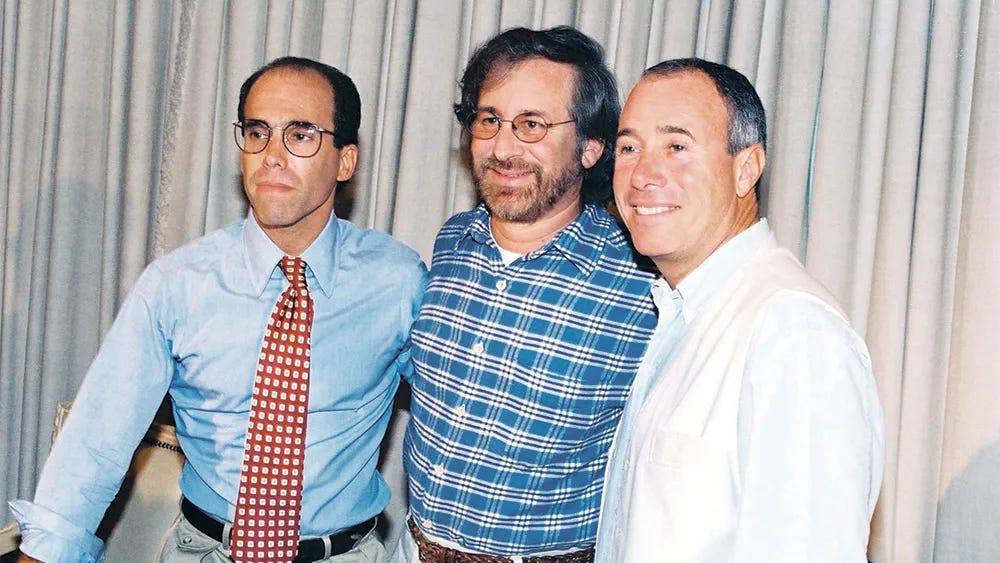
Jeffrey Katzenberg published a new essay on AI recently, and it has people in a twist.
He has previous here. In 2023, the former Disney chairman and DreamWorks co-founder predicted that a world-class animated film, which once took 500 artists several years, would replace 90% of crew labour within three years.
Well, it’s been three years.
Pixar has not replaced 450 animators with a MacBook and an Anthropic subscription, and no major studio is making features at that scale with 50 people yet.
But of course there have been changes. AI-assisted motion capture has cut animation time by 80% on some productions. BITT Animation says its fully generative commercial work now costs 15–20% of the traditional equivalent. In China, shots that once cost tens of thousands of yuan now cost a fraction of that.
Amazon is funding AI-assisted animated series, and Disney is openly using AI to shorten VFX work.
So he was wrong on the date but right on the direction.
His new essay reaches back to the 1920s, when a trip to the cinema meant a live orchestra playing alongside the silent film. Then soundtracks started travelling with the print, and one orchestra could do the work of thousands meaning those jobs vanished.
Using AI to speed up the workflow is a no-brainer by now.
The open question is generative AI that does the work itself, and animation and VFX are where it will land first. Katzenberg isn’t the only one who thinks so. Scott Ross, the Digital Domain co-founder, has been making the same case.
Let’s see how it unfolds.
Meanwhile, in cameras
Someone reverse-engineered DJI’s Pocket cameras into miniature cinema cameras. It’s called OpenPocketCine, and adds a full professional monitoring toolkit for free. It also lets you steer the gimbal by moving your head while wearing AirPods.
ARRI put its colour science inside a smartphone. The HONOR Magic9 Pro Max records native ARRI LogC3 in Wide Gamut 3 and ships with 14 ARRI Looks. ARRI name on the handset but it’s not an Alexa in your pocket. Give phone makers four more product cycles and someone will ship one with a PL mount.
Cinematographers are getting tired of everything looking like an expensive RAW file somebody forgot to grade. An r/cinematography thread complaining about soft shallow-focus images pulled more than 2,300 upvotes. Reddit isn’t the ASC, but anyone who has watched a streaming drama lately knows what they mean.
Somebody also made a feature without using an actual camera. James N. Kienitz Wilkins’ The Misconceived was built from motion capture inside a 3D environment, and he chose the camera positions afterwards. Producer Joey Frank put it best: “The first time this movie sees a lens is when it is projected”.
Archive watch
The BFI restored a Madness film from the only surviving 35mm prints. Take It Or Leave It returns in 4K, built from exhibition prints rather than an original negative, with its Dolby stereo mix intact.
Cut of the Week: Arlo Parks, Get Go
Chloé Desaulles is a creative director who works across stage and interactive as well as screen, which explains her video for Arlo Parks’s “Get Go”.
She wrote her own software to smear the footage until the dancefloor turns into a sloppy memory of a night out. Parks drifts in and out of the crowd while the image melts around her.
Software this strange needs someone to abuse it correctly, and Desaulles certainly does that.
Retail Therapy: A kids’ phone with no feeds

One for the parents here.
Freckle is a kids’ phone with no feeds. Parents pick the apps and send Quests, like photographing three bugs in the backyard.”
Built for small hands and for being dropped, which it will be.
A $25 deposit reserves one for December before it sells for $199.