
Hi everyone —
Where the heck did 2025 go? It’s gone by so blazing fast.
I do love the end of year period as it is a great time to reflect and re-calibrate for the new year. How did I do on my goals? Do I want to add or amend them? What’s going to make the next year epic?
On Eddie AI: we did a lot this year. We made hundreds of app updates. Literally almost every day, sometimes multiple times per day :)
Some of my favorite updates:
Eddie integrates directly with Adobe Premiere Pro, DaVinci Resolve, and Final Cut to pull clips from and send export sequences to. We did a trifecta of launches, back to back to back. (Launch video below.)
Eddie AI v2: a bunch of great updates incl A/B roll logging
Scripted mode v2 launch: Eddie can cut straight to camera videos and choose the best takes. How cool is that.
We turned on subscriptions. It’s validating as a business that what you’ve built is worth paying for. Also prior to this we weren’t 100% clear whose feedback we should listen to. Now it is abundantly clear who are customers and whose feedback we should prioritize.
And we have a lot planned for January 2026.
What should we add to Eddie in 2026? (Or this month. :) )
Thank you for being part of the journey.
—Shamir
Hollywood’s consolidation panic is dominating every trades headline this week. Paramount chasing Warner Bros. for $108 billion while Saudi capital backs the bid.
But the consolidation story is only half of what’s reshaping production. The other half is decentralization: Disney licensing Star Wars IP for AI generation, Letterboxd turning community taste into an indie distribution channel, and Iranian filmmakers proving you can win Cannes without permits or production infrastructure.
This week we tracked both directions at once.
Render Reel
Paramount’s $108B Warner Bros. Discovery Bid Signals Consolidation Panic, Not Strength
As legacy studios scramble to scale against Netflix, creators face fewer greenlights and a tighter, more centralized industry
Sundance 2026 Loads Up on Comedy and Turns Its Park City Farewell Into a Victory Lap
With the festival preparing to leave Utah in 2027, the lineup doubles down on laugh-first indies, restored classics, and a Robert Redford tribute.
Christopher Nolan’s The Odyssey Prologue Leaks Online
The six-minute 70mm IMAX-exclusive preview doesn’t remain exclusive for long.
Letterboxd’s Video Store Turns Taste Into Distribution Power
By translating watchlists and community demand into transactional rentals, Letterboxd sketches a viable indie-first release model.
Hollywood Has a Saudi Problem (And It’s Getting Bigger)
Hollywood is broke, and Saudi Arabia knows it.
Stars are reportedly earning checks as high as $2.5 million for appearances at the Red Sea Film Festival, while studio executives quietly traveled to Jeddah to explore new partnerships. Saudi capital is even rumored to be supporting Paramount’s ambitious $60 billion bid for Warner Bros. Discovery.
The underlying logic is straightforward.
Post-pandemic losses, prolonged strikes, and the escalating cost of competing in the streaming era have tightened traditional funding pipelines. Saudi Arabia, armed with deep reserves and Vision 2030 ambitions, sees an opportunity to invest in culture, infrastructure, and global relevance at once.
The relationship isn’t without friction. Some comedians have faced backlash for performing in the kingdom, and many high-profile attendees remain publicly silent. But that silence also reflects a long-standing industry reality: financing shapes futures, and pragmatism often wins over posture.
For Saudi Arabia, this is less about image repair than long-term positioning.
And judging by the steady flow of talent and executives heading to Jeddah, the strategy is resonating.
A24’s The Drama Campaign Shows Marketing as Part of the Movie Itself
Fake engagement announcements and anxiety-driven teasers reinforce A24’s grip on cultural attention with minimal spend
TIME Names KPop Demon Hunters Breakthrough of the Year, Cementing Netflix’s First True Culture-Dominating Original
The animated K-pop fantasy became the streamer’s most-watched title ever by pairing original IP and hyper-specific Korean cultural texture.
DIGILOG’s iPhone App Challenges Apple’s Locked-Down Camera Pipeline
Rebuilding the image from raw sensor data and offering film-inspired color science, DIGILOG reframes smartphones as legitimate creative cameras.
CREE8’s Acquisition of PRODUCER Accelerates the Shift to Cloud-Native Production
By folding planning, management and delivery into one ecosystem, CREE8 bets that fragmented toolchains are finished.
Berlin Startup gets $41M to solve AI video silent problem
Mirelo, a Berlin-based startup just raised $41 million to fix the glaring AI video sound problem.
The two-year-old company builds AI that watches your video and generates matching sound effects. This could be another missing piece in the puzzle to figure out how to make AI-generated content actually watchable.
Index Ventures and Andreessen Horowitz led the seed round, betting big on a simple insight: sound is half the experience.
But they may already be too late. Sony, Tencent, ElevenLabs, and even Google’s Gemini have shipped competing products. However, Mirelo’s team of 10 (soon to be 30) is focused exclusively on sound effects, not the broader music generation space where competition is fiercer.
The startup targets creators and prosumers at $23.50/month, not Hollywood studios which is smart because there’s an ocean of amateur AI video that desperately needs audio, and professional sound designers weren’t really working on this kind of content anyway. That work usually fell to an overworked editor.
Now, AI is stepping in as a practical assist.
The real question is whether a narrow focus on sound effects is defensible long-term, or just a temporary wedge before the tech giants absorb this feature into their existing video tools.
Universal’s Portrait of God Deal Confirms YouTube as Hollywood’s New Proving Ground
The Sam Raimi and Jordan Peele produced adaptation of Dylan Clark’s viral horror short shows studios treating online shorts as validated IP.
FUJIFILM’s GFX ETERNA 55 Firmware Update Pushes the Camera Into Serious Cinema Territory
Atomos RAW, Open Gate recording, and performance fixes signal Fujifilm’s intent to compete credibly in professional production workflows.
James Cameron Sends Personal Note to Projectionists for Avatar 3
Cameron personally asks theater technicians to follow exact projection and sound specs for Avatar: Fire and Ash, including proper framing and reference volume.
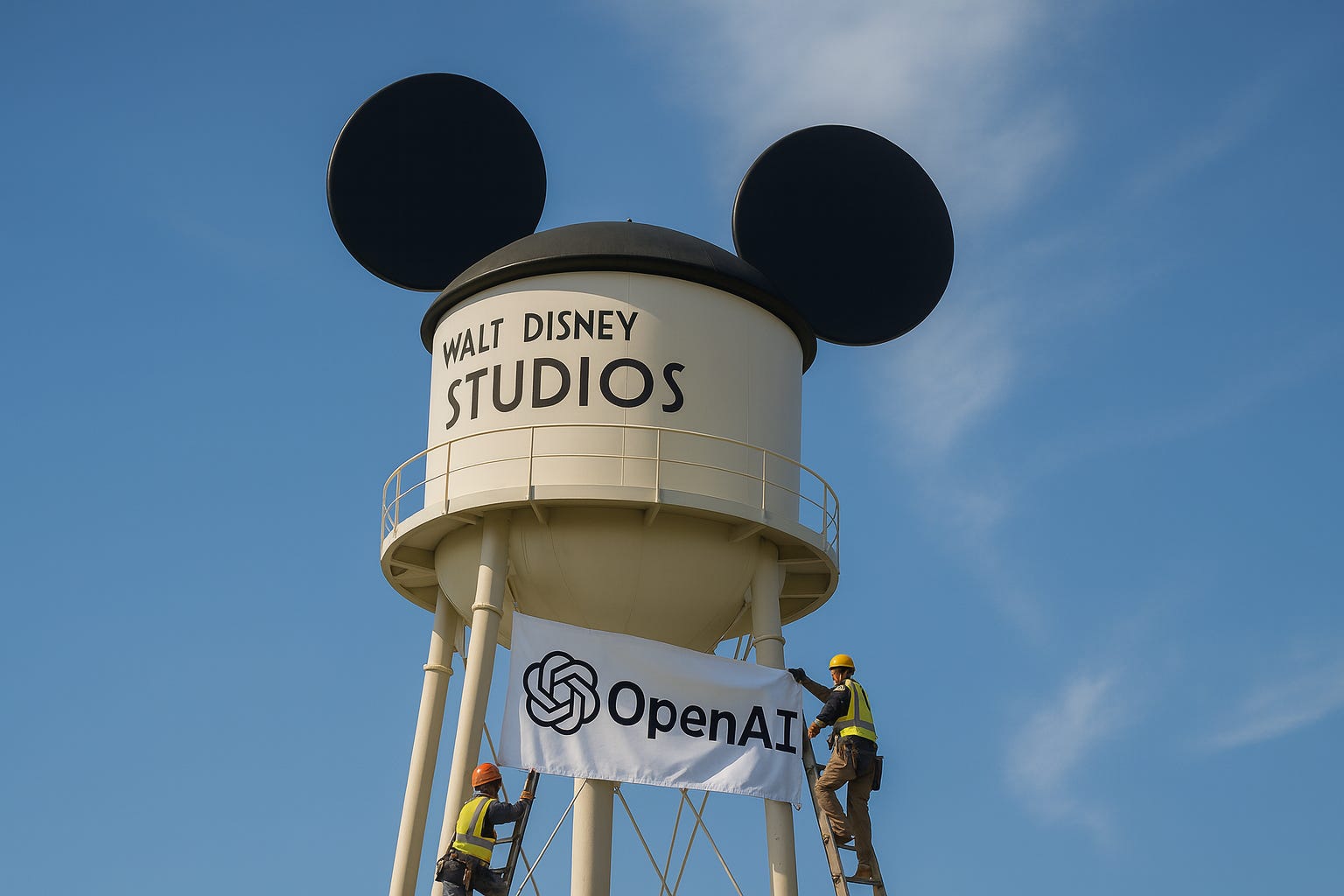
Why Disney Just Spent $1B on OpenAI
Disney just invested $1 billion in OpenAI and licensed 200+ characters from Star Wars, Marvel, and its other franchises. Starting early next year, creators using Sora can generate videos featuring Darth Vader, Spider-Man, or Stitch..legally.
This is a watershed moment because for the first time, indie filmmakers and solo creators can work with IP that was completely untouchable. Want to make a fan film with actual lightsabers and Marvel costumes?
Well, now you can.
A YouTuber can illustrate Star Wars theories with generated footage. Film students can prototype scenes with recognizable characters. Small creators gain access to cultural touchstones that previously required Disney’s permission or deep pockets.
There are legitimate questions about access and equity. Sora will likely require a paid subscription, creating a divide between creators who can afford licensed IP tools and those who can’t.
And while Disney is licensing its own characters for AI use, independent artists are still fighting to protect their work from training datasets.
But Disney’s willingness to license IP for AI generation shows a path forward. If this deal works, other studios might follow, opening up more options for creators rather than fewer.
The key will be whether OpenAI’s pricing makes this genuinely accessible to independent creators, or if it becomes another premium tool that mainly benefits those already established.
Cut of the Week: Jafar Panahi’s ‘It Was Just an Accident’ is a Revenge Thriller Made Without Film Permits
Most filmmakers wait for permits, budgets, and approval but Iranian filmmaker Jafar Panahi managed to shoot a Palme d’Or winner in secret.
No permits. No film commissions. Just a crew small enough to hide in plain sight. The editor even doubled as the driver.
Footage got edited on an 8GB laptop using proxies while the originals stayed hidden for security.
In a recent Academy conversation, Panahi touches on how he pulled it off via turning limitations into methodology. His career has become a masterclass in small-footprint filmmaking but, tragically, out of necessity.
We’re planning a deeper dive on Panahi’s approach, because what he’s doing out of survival is exactly what most indie creators need to learn by choice.
Retail Therapy
Pebble Index 01: The Thought-Catcher Ring: $75

A minimalist smart ring for people who think faster than they type. Press the hidden button, speak your idea, and move on. The ring quietly syncs your voice notes to your phone, turns them into text, and files them for later.
No charging, no cloud processing, no attention-grabbing screen. Just a discreet, stainless-steel reminder that your best ideas don’t always arrive at a desk.
SKG G7 PRO-FOLD Neck Massager with Heat: $199.99

A compact, foldable neck massager built for end-of-day decompression. Nine upgraded massage heads deliver noticeably deeper vibration, while infrared heat and red-light therapy loosen stiff shoulders and improve circulation.
An easy plug-and-play upgrade for anyone spending long hours at a desk, on set, or on the road.
If you’re reading in the app, tap the little ❤️ so we know you’re out there.”