
Also this week:
PlayStation made Hideo Kojima feel “sad”. A Netflix director went to prison after spending $11 million intended for a sci-fi series on crypto and cars. Meanwhile, Spielberg and Amazon won an 11-studio bidding war for The Mandela Catalogue, the latest YouTube horror series headed for cinemas.
Render Reel
Vimeo’s parent company just IPO’d at $18 billion valuation. Bending Spoons hit the Nasdaq at $29 a share and surged 40% on its first day. Their portfolio includes Vimeo, Eventbrite, and AOL (yes, that AOL).
One of Europe’s biggest short film buyers ends short film support. Spain’s Movistar Plus, which has been a key acquirer of international short film co-productions for nearly 30 years, is sadly axing its short film programme.
Hideo Kojima says he is “really sad” about PlayStation phasing out physical discs and worried about what replaces them. Speaking at a film festival in Italy, the Death Stranding director argued that digital downloads still leave players with data stored on their own hardware. Streaming doesn’t as access can disappear the moment a platform changes its terms or shuts down. This comes after PlayStation recently announced it will stop manufacturing physical game discs in January 2028.
The Hollywood director who defrauded Netflix of $11 million just got two and a half years in prison. Carl Erik Rinsch, who directed 47 Ronin, was given $55 million by Netflix to make a sci-fi series called White Horse. He told them he needed $11 million more to finish it but spent it on Rolls Royces, crypto, and mattresses costing hundreds of thousands of dollars.
A doc about the man who invented the steadicam is finally in production
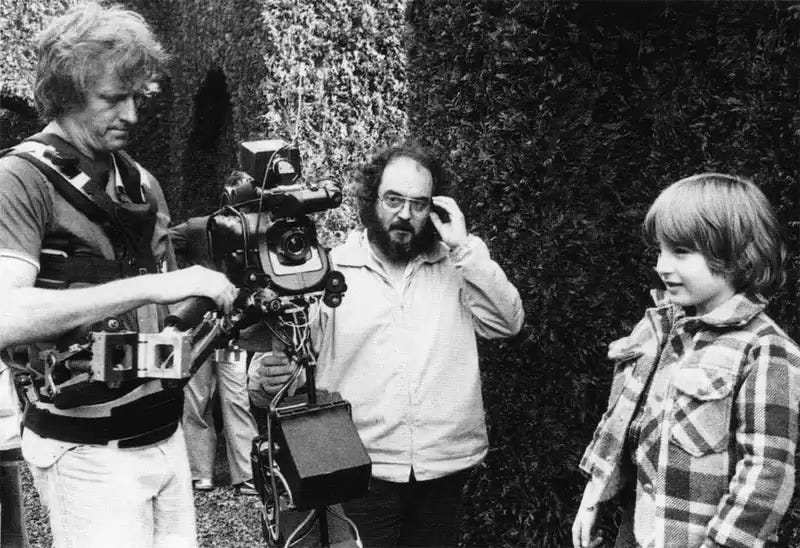
Before 1974, a smooth moving shot meant a dolly track. You had to lay rails, push a cart, and the camera went exactly as far as the track allowed.
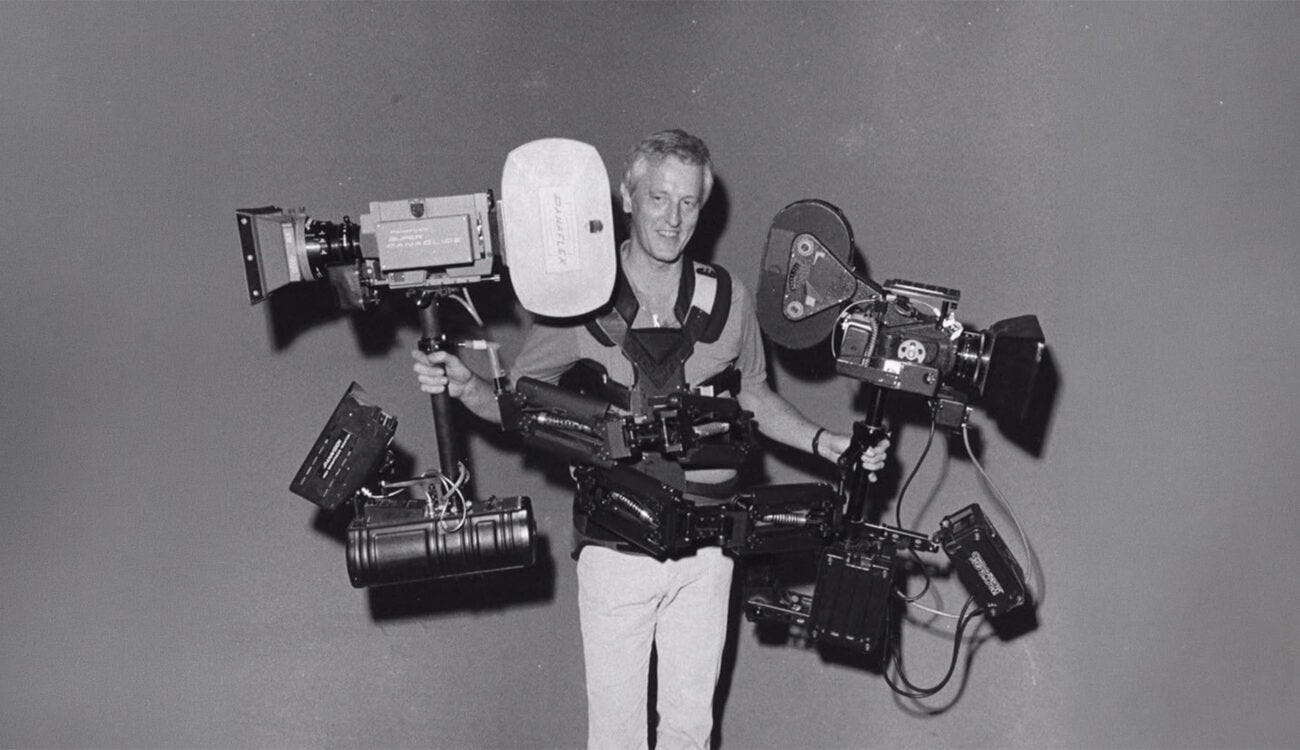
Then a guy called Garrett Brown based out of a barn in Philadelphia built a contraption that let an operator walk, run, climb stairs, and move through space with a camera that seemed to float.
He called it the Steadicam and became the first person to operate it on a film set.
The shots he made with it are ones you already know even if you’ve never heard his name.
Think Rocky running up the museum steps. Or the Overlook Hotel corridor shots in The Shining. Or the speeder bike chase in Return of the Jedi.
Every gimbal you’ve ever held, every stabiliser on every drone, every smartphone rig that promises “cinematic” footage, all traces back to Brown in that barn.
A generation of camera operators now knows the gimbal in their hands far better than the mechanical rig that birthed them all. Which is exactly why a documentary about Brown is now in production.
Thank You Mr. Brown, directed by longtime collaborator Andrew Schwartz, is currently shooting in Philadelphia, New York, and LA with Francis Ford Coppola executive producing.
Schwartz describes Brown as equal parts Einstein and Forrest Gump, which is either the best or worst pitch for a documentary subject and in this case it might be both.
The film connects the threads between that barn workshop and every stabilised shot being taken today.
No release date yet but it’s something worth tracking.
Spielberg and Amazon land YouTube series, The Mandela Catalogue in 11-studio bidding war. The YouTube analog horror series has over 100 million views and is now getting the feature treatment, with creator Alex Kister directing. It’s the third major YouTube-to-theatrical horror deal this year after Backrooms ($331M worldwide) and Obsession ($374M).
A British indie film has collapsed, leaving crew owed more than £300,000 and no one agrees who is to blame. The Climb, originally set to star Cara Delevingne, was due to shoot at Cinecittà using virtual production technology but the financing never arrived and the production company was later liquidated. The financier blames the producer. The producer blames the financier, but the crew aren’t taking sides.
This week we’re watching:
US National archives video clip for To Fly!, the 27-minute IMAX documentary that turns 50 this week. Without it, Christopher Nolan’s filmography as we know it probably doesn’t exist.
In 1976, Greg MacGillivray and Jim Freeman strapped fridge-sized cameras to helicopters, flew one through the St. Louis Gateway Arch without permission, and made a $590,000 film that has since been seen by more than 100 million people.
When the Smithsonian tried to remove it from the National Air and Space Museum, visitors revolted and the Washington Post got involved.
Nolan, who saw it as a child at a theme-park IMAX, remembers watching the entire audience lean in unison as the camera swept over a ridge.
He later called MacGillivray for advice before shooting The Dark Knight’s aerial sequences. Now, as The Odyssey becomes the first feature shot entirely on IMAX 70mm, it will share daily showtimes with To Fly! at that same Smithsonian theatre.
A small, slightly rogue documentary about flight, still casting a very long shadow.
P.S. There’s something deeply ironic about one of the first major IMAX releases only being available online as a 240p promo clip.
Retail Therapy: The instrument that fits in your lunch break

The Enya Cyber-G Pocket is a foldable smart guitar with 14 chord pads, auto-beats, and a built-in 20W speaker system, all weighing less than two pounds.
You can also play individual notes in solo mode or just use it as a Bluetooth speaker when you run out of musical ambition.
It has fifteen-plus tones including piano and guzheng, five drum kits, eight-hour battery, and a fold that gets it small enough for a sling bag.
Available on enyamusicglobal.com for $199.
In the 1970s the Steadicam emerged as the magic tool the camera department used to go places and show things that heretofore were next to impossible to achieve. It was unique. So unique that those trained to operate the device were far and few between.
Today we have tools that weren't even imagined in 1974-75. Many of today's tools do have family lineage dating back to Garret Brown's basic concept: How to move a camera through 3D space while keeping the horizon level both vertically and horizontally while moving through doorways, up and down staircases, and a very cool one where the operator with flying rig stands on a giant crane's platform as it comes down to earth--steps off and floats right into a building to keep the shot going almost indefinitely. Shear visual magic.
Today's devices for moving camera platforms include: Drones, Gimbals, cranes that telescope their boom arm in and out of the center axis point, devices that mount on moving vehicles which accomplish some of the most dazzling changes of perspective while traveling at highway speeds in some cases.
And today we have thousands upon thousands of operators of these devices who are nothing short of athletes worthy of winning an Olympic Gold Medal for the ways in which they handle delicate, intricate, precision tools used in the art and craft of cinematography.
So let's all tip our hats (if you wear one) to Garrett Brown and all who have followed the inventor's pathway of innovation and progress. Thank you one and all for your contributions to the liveliest art of them all.